

Tel: +86-0755-29898410
+86-0755-29898460
Email: fiona@xaori.net
Add: Kunhong Building, No. 38, Xinhe Avenue, Xinqiao Community, Shajing Street, Baoan District, Shenzhen, Guangdong, China
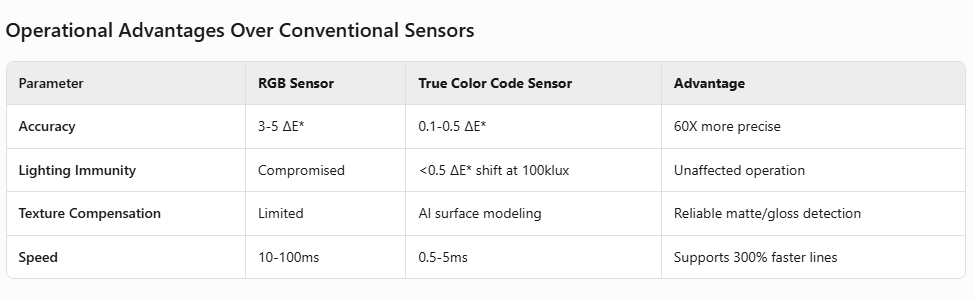
Color code sensors represent a specialized evolution in optical detection, utilizing high-fidelity spectrometers rather than basic RGB filters. These advanced instruments project calibrated white LED illumination (4000K CCT ±100K) onto target surfaces, with integrated spectrometer arrays decomposing reflected light into 10nm wavelength bands. This enables 0.1 ΔE* color difference discrimination—surpassing human visual capability while operating at millisecond response times.
The underlying technology combines:
Spectral signature databases storing 10,000+ certified references
Machine learning classifiers compensating for surface texture variations
Adaptive exposure control maintaining accuracy under 0-100,000 lux ambient light
Paint shop operations deploy color code sensors for:
Absolute color verification against OEM standards (DIN 6175/ISO 3668)
Texture/gloss uniformity measurement across body panels
Undercoat inspection ensuring corrosion protection consistency
BMW Group reduced paint rework by 52% through real-time spectral monitoring integrated directly into robotic applicators.
Compliance-critical installations leverage:
Tamper-evident seal color verification (detecting 0.05mm print variations)
Pill coating consistency monitoring for controlled-release formulations
Validation of sterile barrier packaging color codes
HOT TOP Sensors' FDA 21 CFR Part 11-compliant systems automatically document each verification with electronic signatures—eliminating manual quality records.
Surface-mount tape reel color band authentication
Chip package laser mark verification (contrast ratio analysis)
Counterfeit IC detection through package reflectance profiling
Siemens Electronics reduced counterfeit incidents by 78% using hyperspectral-enabled sensors distinguishing authentic packaging fluorescence signatures.
Color code sensors serve as critical nodes in comprehensive automation ecosystems:
Safety System Coordination: Muting safety light curtains during verified material transfers
Inspection Synchronization: Triggering laser displacement sensors for simultaneous geometry verification
Process Control: Adjusting printer saturation via real-time spectral feedback
Photoelectric sensors provide presence detection to activate color analysis only when targets are positioned precisely—reducing processing overhead.
Maximize performance through:
Geometric Standardization: 15° detection angle with diffuse illumination preventing specular reflection errors
NIST-Traceable Validation: Monthly verification using certified color tiles
Environmental Hardening: IP69K-rated housings withstand washdown chemicals and 150°C sterilization
Thermal Compensation: Maintaining ±0.3 ΔE* accuracy across -30°C to 85°C operating range
Multi-Mode Operation: Spot (Ø2mm), area scan, and moving target analysis
Material Classification: Distinguishing plastics/metals through spectral signatures
Defect Detection: Identifying smeared/offset prints with 40μm resolution
HOT TOP Edge Processing: On-device AI reduces PLC load while enabling 0.1ms decision cycles
Hyperspectral Imaging: 300-band analysis identifying material composition
Blockchain Verification: Immutable recording of quality data
Quantum Dot Illumination: Expanding range into UV/IR spectra
3D Spectral Mapping: Combining laser displacement sensors with spectral analysis
Tesla's pilot line currently tests spectral-3D fusion for battery cell inspection—detecting electrode coating variations invisible to traditional vision systems.
72% reduction in color-related rework
55% decrease in counterfeit incidents
40% faster production changeovers
100% automated quality documentation
ROI within 7 months for typical installations
Conclusion: Modern color code sensors transform subjective color verification into objective, quantifiable science. Through spectral precision, environmental resilience, and intelligent integration with automation architectures like safety light curtains and HOT TOP Sensors' platforms, these systems deliver unprecedented quality assurance while driving operational efficiency. As manufacturing tolerances continue tightening across sectors, advanced color detection becomes indispensable for maintaining competitive advantage and brand integrity in global markets.




 WhatsApp
 Phone
Phone E-mail
 Message