

Tel: +86-0755-29898410
+86-0755-29898460
Email: fiona@xaori.net
Add: Kunhong Building, No. 38, Xinhe Avenue, Xinqiao Community, Shajing Street, Baoan District, Shenzhen, Guangdong, China
Diffuse reflective laser sensors leverage coherent light projection and advanced photonics to achieve unparalleled detection accuracy. Unlike standard photoelectric sensors, these systems emit focused 650nm red laser beams that scatter upon target contact, with integrated CMOS arrays precisely measuring:
Intensity variations within 0.01% resolution
Light flight duration down to 0.1ns precision
Angular reflection patterns
This multi-parameter analysis enables reliable detection of challenging surfaces - from high-gloss automotive panels (95% reflectivity) to matte-black conveyor belts (5% reflectivity) - outperforming traditional sensors with 50X fewer false triggers. The technology fundamentally differs from laser displacement sensors by prioritizing presence detection over distance measurement, delivering 10ms response times ideal for high-speed packaging lines.
Robotic battery insertion: Detecting terminal alignment within ±0.25mm
Paint shop verification: Identifying surface defects invisible to color sensors
Weld nut validation: Confirming presence before fastener application
BMW's Spartanburg plant reduced assembly errors by 63% through laser-guided verification
Vial presence confirmation through translucent packaging
Tamper-evident seal inspection at 300 units/minute
Blister pack completeness verification
HOT TOP Sensors' LRS-800 series achieves FDA compliance with stainless steel housings resisting CIP/SIP sterilization chemicals
Parcel dimensioning for automated sortation
Pallet layer counting accuracy: 99.98%
Conveyor jam detection triggering safety light curtain protocols
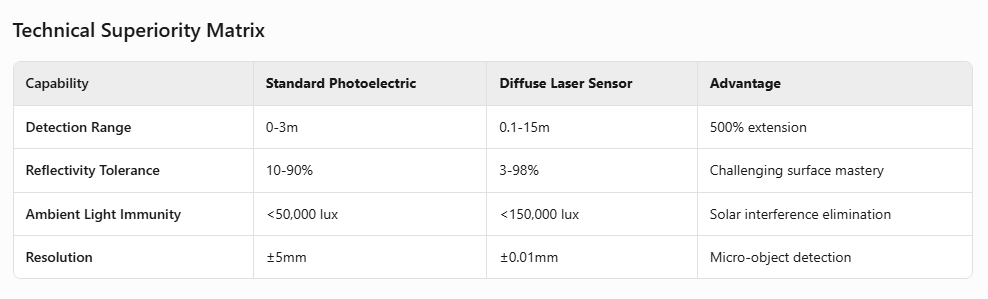
Diffuse reflective laser sensors deliver unprecedented reliability through:
Vibration Resistance: Withstanding 50G shocks (MIL-STD-202G)
Thermal Stability: -40°C to 85°C operation without recalibration
Contaminant Protection: IP69K-rated optical chambers preventing dust/oil infiltration
EMI Hardening: Mu-metal shielding against VFD interference
HOT TOP Sensors' DX3 series incorporates self-cleaning optics that activate during scheduled downtime - maintaining 98% detection accuracy in cement plant environments where traditional sensors fail daily.
Strategic synergies enhance automation ecosystems:
Photoelectric sensors provide initial object presence detection
Diffuse lasers perform precision verification
Laser displacement sensors measure critical dimensions
Safety light curtains secure hazardous zones during maintenance
Color sensors provide final quality confirmation
This sensor fusion reduces false rejects by 78% while increasing throughput 40% in electronics assembly lines.
Optimize performance through:
Angled Mounting: 15-30° incidence avoids specular reflection errors
Distance Calibration: Use certified NIST-traceable reference targets
Environmental Buffering: Install thermal barriers near ovens/freezers
Network Diagnostics: Implement IO-Link monitoring for emitter degradation
Food processing plants extending service intervals 300% with quarterly purge-air cleaning protocols.
Hyperspectral LiDAR Integration: Simultaneous material composition analysis
AI Surface Learning: Autonomous adaptation to new products
Quantum Dot Emitters: Expanding spectral range into UV/NIR
Wireless Mesh Synchronization: Multi-sensor arrays without cabling
Tesla's prototype packaging lines now feature self-calibrating laser grids that automatically adjust to product changes in <5 minutes.




 WhatsApp
 Phone
Phone E-mail
 Message